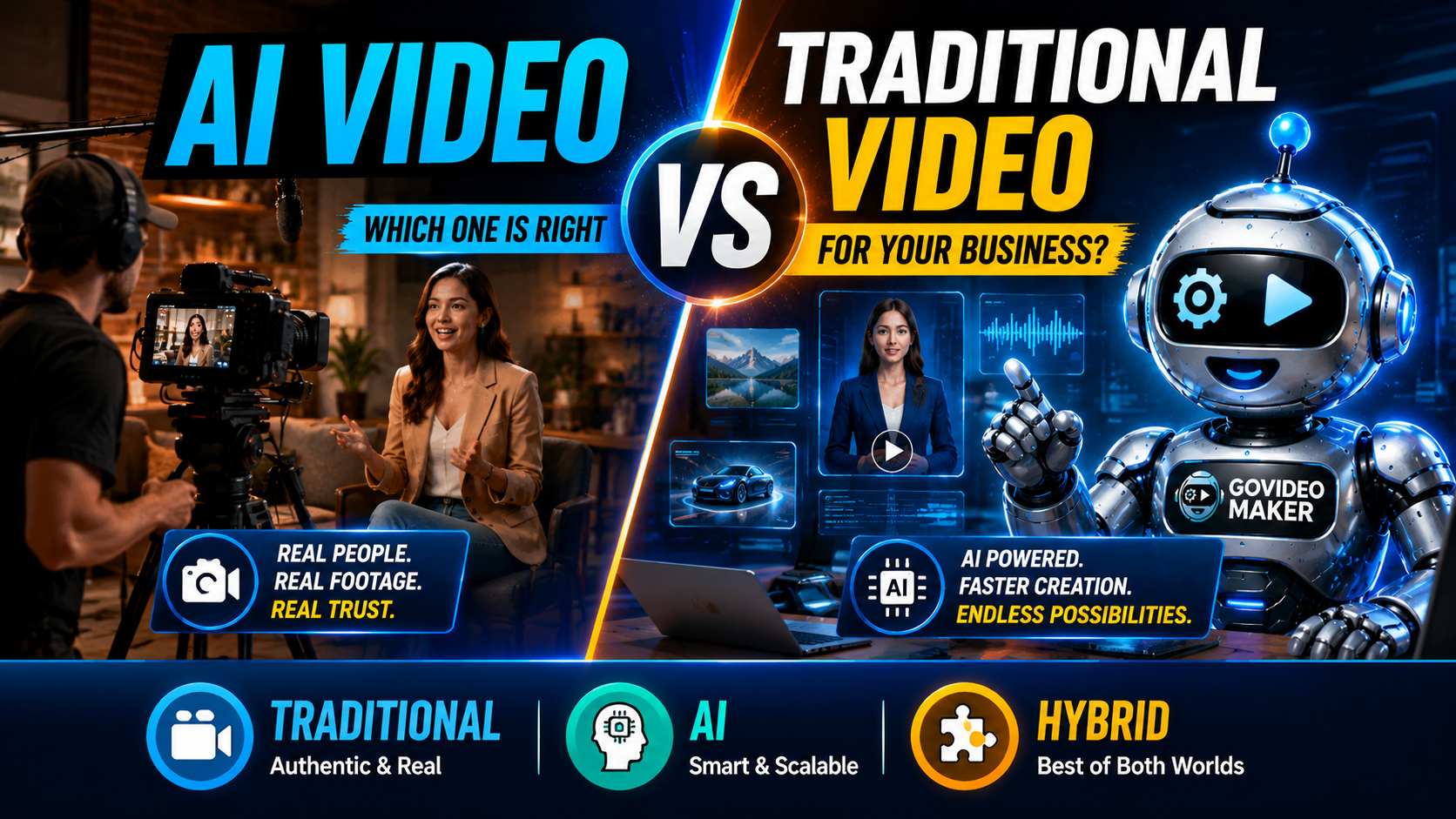
A few years ago, creating a professional business video usually meant one thing:
Get a camera. Find a location. Set up the lights. Record. Edit.
Today, there’s another option.
AI can generate presenters, voices, environments, animations, product scenes, characters, and even realistic-looking footage without a traditional shoot.
That naturally raises a question we hear more and more:
Should my business use AI video or traditional video?
The answer isn’t as simple as choosing the newest technology.
Sometimes AI makes perfect sense.
Sometimes nothing beats a real camera.
And increasingly, the best answer is actually a combination of both.
Here’s how we look at it.
What Do We Mean by Traditional Video?
Traditional video is exactly what most people imagine when they think about video production.
You record something that actually happened in front of a camera.
That could be:
- A business owner speaking to the camera
- A customer giving a testimonial
- A walkthrough of a property
- A chef preparing a dish
- A product demonstration
- Employees working
- An event
- Behind-the-scenes footage
It doesn’t necessarily mean a huge production crew.
A smartphone, good lighting, decent audio, and thoughtful editing can produce excellent business content.
The biggest advantage is obvious:
It’s real.
You’re showing the actual person, place, product, or experience.
And there are situations where that matters enormously.
Where Traditional Video Still Wins
Imagine you’re choosing a hotel.
Would you rather see an AI-generated version of the swimming pool—or the actual swimming pool?
Probably the real one.
The same applies to many businesses.
If customers need to evaluate something that physically exists, authentic footage can be extremely valuable.
Real People Build Trust
If you’re a consultant, doctor, agent, coach, business owner, or other professional whose personality is part of the service, appearing on camera can help people feel like they know you before they ever contact you.
AI doesn’t automatically replace that connection.
Real Experiences Need Real Evidence
Testimonials are another example.
If an actual customer is willing to talk about their experience, that’s powerful.
We wouldn’t recommend replacing a genuine customer testimonial with an AI-generated person pretending to be one.
Technology should help communicate reality—not manufacture evidence that doesn’t exist.
Some Things Simply Need to Be Shown
Restaurants.
Hotels.
Properties.
Events.
Physical locations.
Real transformations.
Certain product demonstrations.
If what the customer sees is important to their buying decision, real footage deserves serious consideration.
So Where Does AI Video Make Sense?
AI becomes interesting when traditional production creates unnecessary barriers.
Imagine you need a simple 30-second explainer.
The script is ready.
But producing it traditionally might mean finding a presenter, arranging a location, setting up equipment, recording multiple takes, editing everything, and potentially doing it all again when one sentence changes.
An AI presenter may be able to communicate that same message much more efficiently.
That’s not automatically better.
But it’s another option.
And sometimes it’s exactly the option a business needs.
AI Can Help When You Don’t Want to Be on Camera
Not every business owner wants to become a content creator.
Some people love being on camera.
Others would rather do almost anything else.
That shouldn’t prevent a good business from using video.
AI presenters, talking photos, voiceovers, animation, product footage, screen recordings, and generated visuals can all help tell the story without requiring the owner to become the presenter.
AI Can Visualize Things You Can’t Easily Film
This is where things get fun.
Suppose your video needs to show:
A futuristic city.
A historical scene.
A cartoon character.
An impossible camera angle.
A visual metaphor.
A stylized comic-book world.
A cinematic environment that doesn’t exist.
Traditionally, some of those ideas could require actors, sets, animation teams, special effects, or a very large budget.
AI can make certain concepts much more accessible.
That doesn’t mean every business video should suddenly look like a Hollywood science-fiction movie.
But your creative toolbox just became much bigger.
AI Can Also Make Bad Videos Faster
This part doesn’t get talked about enough.
AI can make production faster.
Unfortunately, it can also make bad production faster.
You can generate a beautiful scene that has nothing to do with the message.
You can create an AI presenter reading a script nobody wants to hear.
You can generate ten videos instead of one—and end up with ten boring videos.
The technology doesn’t solve the fundamental questions:
Who is this for?
What are we trying to communicate?
Why should somebody care?
What should they do afterward?
Those decisions still matter.
What About Cost?
AI can reduce certain production costs because you may not need as many physical production resources.
But it’s misleading to think:
AI = free video production.
Good AI video can still require scripting, prompting, generation, multiple attempts, visual consistency work, voice production, editing, B-roll, captions, sound design, music, graphics, and quality control.
Sometimes getting a usable AI scene takes several generations.
And sometimes filming the real thing is actually simpler.
The goal shouldn’t be to use AI at every possible opportunity.
The goal should be to use the most practical production method for the job.
There’s a Third Option: Hybrid Video
This is probably the approach we’re most excited about.
You don’t necessarily have to choose between:
100% traditional
or
100% AI-generated.
You can combine them.
For example, imagine a business already has good product footage.
We can use that real footage for the parts where authenticity matters.
Then add:
AI-generated B-roll.
Motion graphics.
Voiceover.
An AI presenter.
Animated photographs.
Visual effects.
Captions.
Stock footage.
Screen recordings.
Suddenly we’re not asking:
“Is this an AI video?”
We’re asking:
“Does this combination communicate the idea effectively?”
That’s a much more useful question.
Here’s a Simple Way to Decide
Choose traditional video when reality itself is part of what you’re selling.
Choose AI video when you need flexibility, visualization, scalable presenter content, or scenes that would be difficult to produce traditionally.
Choose a hybrid approach when you want the authenticity of real assets combined with the flexibility of modern AI production.
For example:
Restaurant: Real food footage + editing + graphics + voiceover.
Real estate: Actual property footage + AI-enhanced visual storytelling + motion graphics.
Ecommerce: Real product images/footage + UGC-style presentation + AI-generated supporting scenes.
Professional service: Real owner introduction + B-roll + graphics + AI-assisted explainer sequences.
Online business: Screen recordings + AI presenter + voiceover + motion graphics.
There’s no universal formula.
And that’s exactly the point.
Don’t Choose the Technology First
One of the easiest mistakes to make right now is starting with:
“I want an AI video.”
Before deciding that, ask:
What are we trying to show?
Maybe AI is perfect.
Maybe your phone camera is perfect.
Maybe you already have everything you need sitting in your photo library.
The production method should come after the idea and objective, not before them.
That’s how we approach video creation at GoVideoMaker.
We’re not interested in forcing every project into the same format simply because a particular technology is popular.
Sometimes the right answer is AI.
Sometimes it’s real footage.
And sometimes the strongest result comes from combining both.
So, AI or Traditional Video?
Neither wins automatically.
The better question is:
Which approach will communicate your message most effectively?
Technology will continue changing.
AI video will get better.
Cameras will get better.
Editing tools will get better.
But businesses will still need to do the same fundamental thing:
Give people a reason to watch—and something worth remembering.
Everything else is a production decision.
Not Sure Which Approach Your Project Needs?
Tell GoVideoMaker what you want to promote, explain, sell, or share.
You don’t need to decide whether it should be AI-generated, traditionally filmed, or a combination of both before contacting us.
Bring the idea. We’ll help figure out the video.
Create Better Videos, One Useful Idea at a Time.
Get practical video marketing strategies, AI video tips, and creative inspiration delivered to your inbox.

You May Also Like