ou know your business needs video.
But then comes the harder question:
What kind of video should you actually create?
A Reel? A product demo? An explainer? An AI presenter? A customer story?
With so many formats available today, it’s easy to assume you need to try everything.
You don’t.
The right video depends on what you’re trying to accomplish, what your audience needs to understand, and where they’re going to watch it.
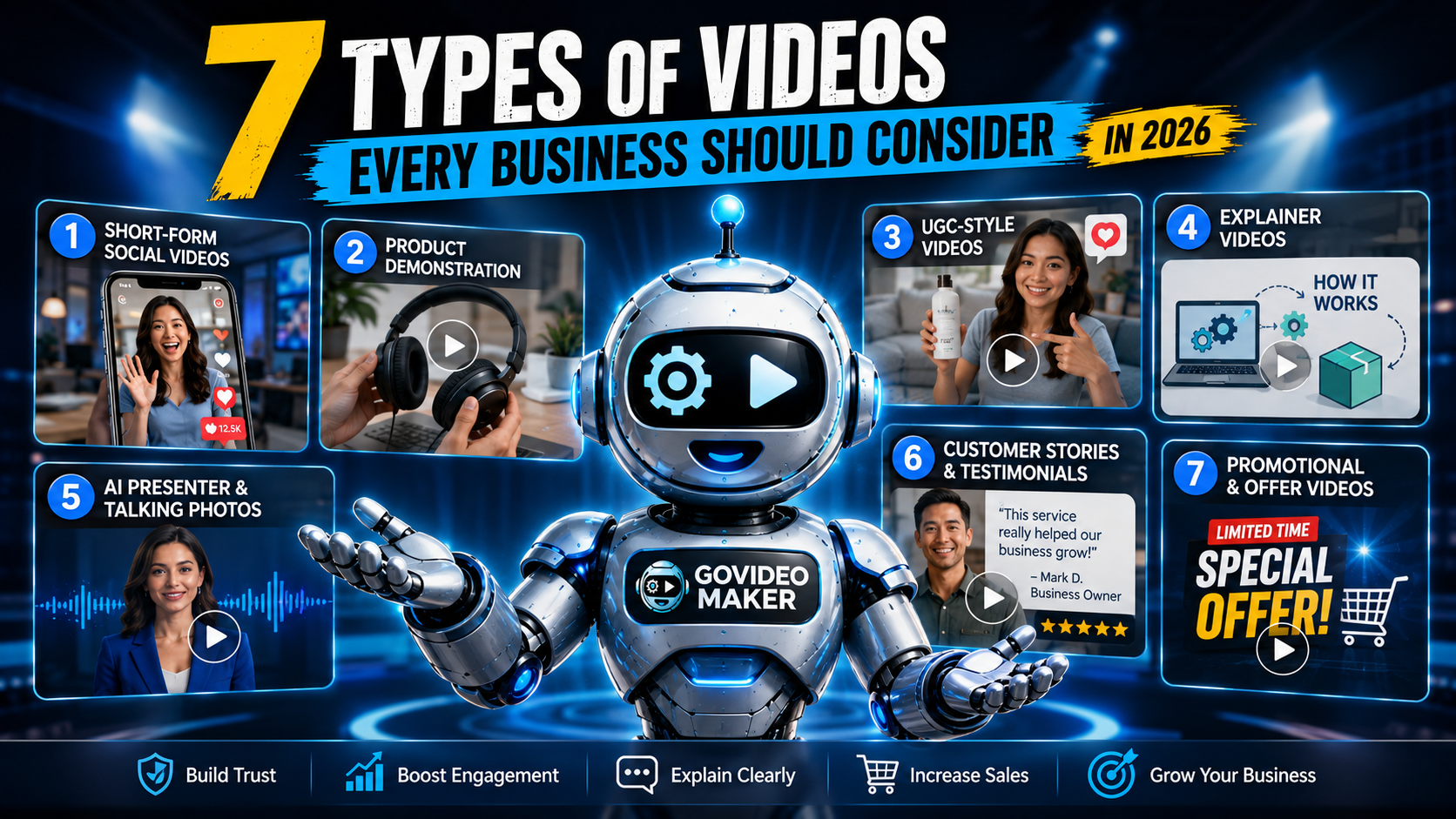
Here are seven video formats worth considering—and when each one actually makes sense.
1. Short-Form Social Videos
Let’s start with the obvious one.
Short-form videos for Facebook, Instagram, TikTok, and YouTube can be one of the easiest ways to regularly put your business in front of people.
But “short-form” doesn’t mean randomly cutting a longer video down to 30 seconds.
A good short usually has one clear idea.
For example:
A restaurant could show how its signature dish is prepared.
A contractor could share one mistake homeowners should avoid.
A salon could show a quick transformation.
A real estate agent could highlight three features of a property.
An online seller could demonstrate one reason a product is useful.
The goal isn’t to explain your entire business.
It’s to earn enough attention for someone to remember you—or take the next step.
Best for: Awareness, engagement, quick tips, promotions and regular social media content.
2. Product Demonstration Videos
If you sell something people can see, hold, wear, eat, install or use, don’t just describe it.
Show it.
A product demonstration answers questions that photographs sometimes can’t.
How big is it?
How does it work?
What does it look like in actual use?
What’s inside the package?
How does it solve the problem?
You don’t necessarily need a presenter standing beside the product either.
Hands-on footage, close-ups, text, B-roll and a simple voiceover can be enough.
And depending on the product, this straightforward approach can feel much more believable than an overly polished advertisement.
Best for: Ecommerce, food, beauty products, gadgets, household products and physical goods.
3. UGC-Style Videos
UGC-style videos are designed to feel more like content you’d naturally encounter in your feed than a traditional commercial.
Think:
“I tried this because…”
“Here’s what surprised me…”
“If you have this problem, take a look at this…”
The relaxed presentation is part of the appeal.
But there’s an important distinction.
UGC-style doesn’t mean pretending a paid actor or AI character is a genuine customer when they aren’t.
You can use the natural, relatable style of UGC while still being transparent about what the video represents.
The goal is authenticity in the presentation, not deception.
Best for: Products, apps, consumer services, social advertising and relatable problem-solution content.
4. Business & Service Explainer Videos
Some businesses have a different problem:
People don’t immediately understand what they do.
That’s where an explainer video becomes useful.
Instead of giving someone several paragraphs to read, a short video can walk them through:
The problem → your solution → how it works → what happens next.
And an explainer doesn’t necessarily require animation.
It could use:
real footage, screen recordings, graphics, stock footage, AI-generated visuals, an AI presenter, voiceover, or a combination of several formats.
The production method matters less than whether someone finishes the video thinking:
“Okay. Now I understand.”
That’s the job of an explainer.
Best for: Professional services, agencies, software, complicated products, new offers and businesses that need to educate customers before selling.
5. AI Presenter & Talking Photo Videos
This is one of the areas where video production has changed dramatically.
A business no longer needs to schedule a filming session every time it wants a presenter-led video.
AI presenters can deliver scripts for explainers, educational content, FAQs, announcements and social videos.
Still photographs can also be animated into talking-photo style content.
Does that mean every business should replace real presenters with AI?
No.
Sometimes a real person is exactly what the video needs.
But AI gives businesses another option when filming isn’t practical, the owner doesn’t want to appear on camera, or content needs to be produced more consistently.
Used well, it’s not about replacing people.
It’s about removing some of the barriers that prevented the video from being created in the first place.
Best for: Educational videos, explainers, announcements, FAQs, multilingual content and businesses that don’t want to film every video.
6. Customer Stories & Testimonials
You can tell people your business is great.
It’s usually more powerful when somebody else does.
A strong customer story isn’t simply:
“Great company. Five stars!”
The interesting part is the journey.
What problem did the customer have?
What were they trying to accomplish?
Why did they choose your product or service?
What happened afterward?
Even a relatively simple testimonial becomes more interesting when it’s structured as a story rather than a collection of compliments.
And if you have genuine reviews but no recorded customer footage, you can still create videos that visually present those real reviews using text, graphics, product footage or relevant B-roll.
Just keep the source authentic.
Best for: Building trust, overcoming objections, service businesses, high-consideration purchases and retargeting.
7. Promotional & Offer Videos
Sometimes you don’t need to educate someone for three minutes.
You have an offer.
And you need people to know about it.
Maybe you’re launching something.
Running a limited promotion.
Introducing a new service.
Opening a new location.
Offering a package.
Or simply reminding existing customers about something they may have overlooked.
That’s when a focused promotional video makes sense.
The structure can be remarkably simple:
Hook → Offer → Why It Matters → Call to Action.
The mistake is trying to turn every video into a promotion.
If everything you publish says BUY NOW, people eventually stop paying attention.
Promotional videos work better when they’re part of a broader content mix that also helps, informs, entertains or educates your audience.
Best for: Offers, launches, events, packages, seasonal campaigns and direct-response advertising.
So Which Video Should Your Business Make First?
Start with your objective.
If people don’t know you exist, consider short-form social videos.
If they don’t understand your product, make a demonstration.
If they don’t understand your service, create an explainer.
If trust is the problem, show real customer stories or testimonials.
If you need presenter-led content but filming is slowing you down, consider an AI presenter or talking-photo format.
If you’re launching an offer, create a promotional video.
That simple decision is more important than choosing which camera, editing app or AI platform to use.
You Don’t Have to Choose Just One Format Forever
Here’s where things get interesting.
The same business idea can often become several different videos.
Imagine you’re launching a new service.
You might create:
A short Reel that introduces the problem.
A longer explainer showing how your service solves it.
A FAQ video addressing the biggest objection.
A customer story that provides proof.
And finally, a promotional video inviting people to get started.
That’s no longer one video.
It’s a small content system built around one idea.
And that leads to something we’ll explore more in another article: how to turn one business idea into an entire week of video content.
The Technology Changed. The Principle Didn’t.
We now have access to production methods that would have been difficult or expensive for many small businesses just a few years ago.
AI-generated video.
Talking photos.
Realistic AI presenters.
Image-to-video.
Advanced animation.
Voice generation.
Traditional footage can now be combined with all of them.
That’s exciting.
But none of those technologies answers the most important question:
What should we show the customer?
Figure that out first.
Then choose the video format—and the technology—that helps communicate it clearly.
Because a sophisticated video nobody wants to watch isn’t necessarily better than a simple video that gets the message exactly right.
Not Sure Which Type of Video Fits Your Business?
You don’t need to figure out the production method before contacting us.
Tell GoVideoMaker what you’re trying to promote, explain, sell or share.
We’ll help determine the video format that makes sense for the idea—and turn it into something worth watching.
Create Better Videos, One Useful Idea at a Time.
Get practical video marketing strategies, AI video tips, and creative inspiration delivered to your inbox.

You May Also Like